| NEW ORLEANS (AP) - A U.S. army soldier who fled to Alberta, rather than return to Iraq, spent Thanksgiving week gutting houses flooded more than a year ago by hurricane Katrina. | |
Sunday, November 26, 2006
Kyle Snyder in New Orleans


Friday, November 24, 2006
Iraq Vets and War Resisters Protest School of Americas
| Kyle Snyder and Darrell Anderson joined the Iraq Veterans Against the War to protest the School of Americas at Fort Benning, Georgia. When Kyle was introduced onstage by Col. Ann Wright (ret.), along with Darrell and the vets, they all received an emotional standing ovation. | |
Thursday, November 23, 2006
Kyle Snyder Helps Rebuild in New Orleans
| War resisters Kyle Snyder and Darrell Anderson help Iraq Veterans Against The War and Volunteers from Common Ground Relief to gut homes at Camp Liberty, Slidell, on the Bayou near New Orleans. Music by IVAW member Dennis Kyne. Rap by Darrell Anderson. | |
Sunday, November 12, 2006
Kyle Snyder, AWOL in America, Travels and Speaks Against U.S. War on Iraq
 Dear friends,
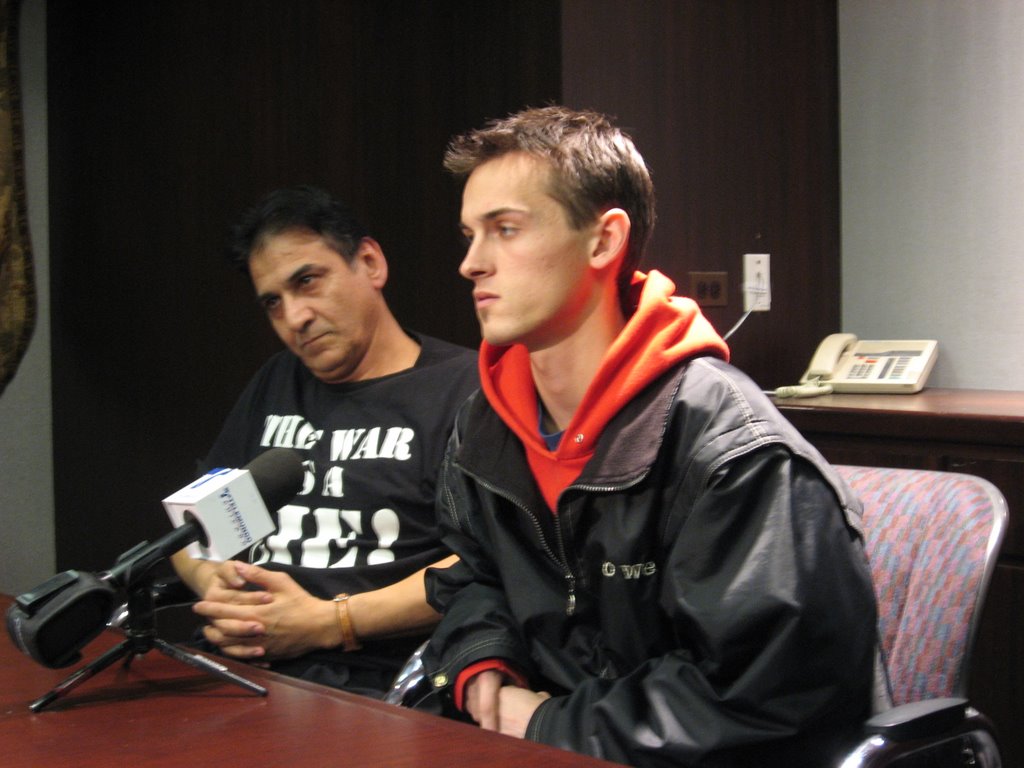
I continue to travel with Iraq war veteran and resister, Kyle Snyder, who remains AWOL after returning last week from Canada and attempting to be discharged from the Army. Right now we are in Chicago, where Kyle spoke to a well attended press conference on Monday, calling on the people of Illinois to vote against the war policies of the Bush administration. (They did, supporting a referendum to withdraw U.S. troops from Iraq by an 8-1 margin!)
We are finding lots of support in Chicago, from veterans groups, military familes, peace groups and others. Kyle has been speaking in public forums and to university students. There continues to be a lot of national and international media interest in Kyle's struggle to be discharged from the Army.
On Thursday, Nov. 9, at 11 pm EST, Kyle was interviewed on the Alan Colmes radio show, which airs on 60 radio stations throughout the U.S. His 30-minute interview then generated another hour-and-a-half of discussion with calls from veterans who testified about war crimes in Iraq and Vietnam as well as recruiters' lies. To hear this interview, go go http://www.foxnews.com/radio/alancolmes/index.html
The Army has not yet given a reasonable response to our call for Kyle to be released from military service without any punishment. At one point, Kyle had been willing to accept an Other Than Honorable discharge that we understood the Army was offering him. But this deal evaporated when he presented himself to Army authorities at Fort Knox, Kentucky.
So Kyle is AWOL again. (AWOL's new meaning: "A War Of Lies") At the risk of arrest, he is speaking out bravely on behalf of war resisters and active duty GI's. His old unit, the 94th Engineers, now based at Fort Leonard Wood, Missouri, is slated to return to Iraq in January for the 3rd time. The Army wants Kyle to return to that unit, and will not say what they will do if does. Could they order him back to Iraq?
Thanks to all of you who have made calls to the Commanding General at Fort Knox, Kentucky. The phones have been ringing off the walls there. Now it is time to make the phones ring at Fort Leonard Wood. Say hello to Fort Leonard Woods's brand new commander, Major General William McCoy, Jr., recently returned from the U.S. occupation of Iraq (you can read his emotional address upon assuming his new command at http://www.flw-guidon.com/).
Here are the numbers to call at Fort Leonard WoodOffice of the Commanding General (that's how they answer) 573-596-0131Public Affairs Office, tel. 573-563-4013 or 4105, fax: 573-563-4012, email: alleym@wood.army.mil
We want to deliver one clear message:
RELEASE KYLE SNYDER WITHOUT ANY PUNISHMENT
For more information on Kyle's campaign and how you can support it, please visit the webiste of Courage To Resist, http://www.couragetoresist.org/. Monies are much needed and you can make an online donation there.
Last Friday, Nov. 3, Kyle was interviewed by Amy Goodman and Juan Gonzales on Democracy Now. You can watch or listen to this interview at http://www.democracynow.org/article.pl?sid=06/11/03/1431228. You can also read and/or download a written transcript.
Another Iraq war veteran and resister,Ivan Brobeck, returned from Canada on election day to the Marine base at Quantico, Virginia. Ivan was recruited into the Marines when he was 17 and fought in Iraq when he was only 19. Ivan is prepared to face a court martial, if necessary. The Marines have not yet decided what they will do with him. To read Ivan's open letter to President Bush, go to http://www.couragetoresist.org/ivanbrobeck/index.php?option=com_content&task=view&id=17
Below are links to two articles I have written about U.S. war resisters. They were published, respectively, by Z magazine and CCCO's Objector. The Z magazine article includes much of the Counseling Memo of the War Resisters Support Campaign in Canada (http://www.resisters.ca/), and the Objector article discusses the injustice of the military's handling of Conscientious Objectors.
Sanctuary and Counseling for War Resisters (Z Magazine)http://zmagsite.zmag.org/JulAug2006/condon0706.html
Support for War Resisters Grows (The Objector, pg. 11)http://www.objector.org/2006JulyObjector.pdf
GI's (or their families) who are seeking discharge from the military or need counseling on how to deal with other issues they may be facing within the military are well advised to contact the GI Rights Hotline, 405 14th Street, Suite #205, Oakland, CA 94612, toll free number: (800) 394-9544 (from the US), (215) 563-4620 (from other countries) Fax: (510) 465-2459, Email: girights@objector.org, web: http://www.girights.org/
Active duty GI's who have information and support will be more likely to follow their consciences and to obey international and U.S. laws against illegal wars and war crimes.
Supporting war resisters is more important than ever. Who else will hasten the end to the unjust, illegal, and unwinnable wars in Afghanistan and Iraq?
for peace and justice,
Gerry Condon
(206) 306-4103
_______________________________________________
Soldier Say No / Project Safe Haven
SoldierSayNo@yahoo.com, projectsafehaven@hotmail.com
http://www.soldiersayno.blogspot.com/
Tuesday, August 15, 2006
Veterans and War Resisters Enjoy Solidarity Picnic on US-Canada Border
by Gerry Condon
In a show of support for GIs who are refusing to fight in Iraq, 150 veterans traveled to the U.S.-Canada border on Sunday, Aug. 13, for a “solidarity picnic” with war resisters seeking sanctuary in Canada. Two buses and a caravan of cars ferried members of Veterans For Peace from their national convention in Seattle to Peace Arch Park, a neutral zone on the border between Washington State and British Columbia.
U.S. war resisters were accompanied by Canadian supporters, including World War II veterans. The War Resisters Support Campaign, with chapters across Canada, co-sponsored the event with Veterans For Peace.
“This is the worse combat situation since Vietnam. War crimes are being committed every single day,” said Kyle Snyder, 22, who was a machine gunner in Iraq. “When I reported the shooting of an innocent civilian, my superiors didn’t even bother to investigate,” continued Snyder, one of 30 U.S. military personnel who have applied for refugee status in Canada.
Colonel Ann Wright (ret.) told Snyder he was doing the right thing. “There is a time honored tradition in the U.S. military to refuse to follow illegal orders or to commit war crimes,” said Col. Wright, who resigned from the U.S. State Department in protest of the Iraq War.
“We’re here today to tell the war resisters that we are behind them 100 percent,” said Dave Cline, national president of Veterans For Peace. Cline, a highly decorated veteran who was wounded three times in the Vietnam War, called on the Canadian government to provide sanctuary for U.S. war resisters.
Musicians from both sides of the borders sang songs of peace while the 300 participants enjoyed a family style picnic in a festive atmosphere. Members of Iraq Veterans Against the War held friendly conversations with their war resister peers in Canada, and invited them to join their growing organization. Several of the war resisters have already fought in the Iraq War but fled to Canada after being ordered back for a second tour.
Kelly Dougherty, a woman who fought in Iraq, met with two young women who are AWOL from the U.S. Air Force. Dougherty, who was recently elected board chairperson of Iraq Veterans Against the War, has also been speaking out in support of Army Specialist Suzanne Swift, who has refused to return to Iraq after being sexually harassed by several of her superiors.
Suzanne Swift is currently awaiting her fate at Fort Lewis, Washington, where Sgt. Kevin Benderman has been imprisoned for 15 months for refusing to return to Iraq, and Lt. Ehren Watada, the first commissioned officer to refuse deployment to Iraq, is awaiting court martial.
Sgt. Ricky Clousing, who served in Iraq as an interrogator for the US Army's 82nd Airborne Division, announced his refusal to deploy to Iraq during the Veterans For Peace convention. Clousing gave himself up to military authorities at Fort Lewis.
Check out Jeff Paterson's excellent photos of the Solidarity Picnic.
http://www.indybay.org/newsitems/2006/08/14/18297229.php
For more information on how you can help the war resisters in Canada and the U.S., visit www.Resisters.ca and www.CourageToResist.org.
In a show of support for GIs who are refusing to fight in Iraq, 150 veterans traveled to the U.S.-Canada border on Sunday, Aug. 13, for a “solidarity picnic” with war resisters seeking sanctuary in Canada. Two buses and a caravan of cars ferried members of Veterans For Peace from their national convention in Seattle to Peace Arch Park, a neutral zone on the border between Washington State and British Columbia.
U.S. war resisters were accompanied by Canadian supporters, including World War II veterans. The War Resisters Support Campaign, with chapters across Canada, co-sponsored the event with Veterans For Peace.
“This is the worse combat situation since Vietnam. War crimes are being committed every single day,” said Kyle Snyder, 22, who was a machine gunner in Iraq. “When I reported the shooting of an innocent civilian, my superiors didn’t even bother to investigate,” continued Snyder, one of 30 U.S. military personnel who have applied for refugee status in Canada.
Colonel Ann Wright (ret.) told Snyder he was doing the right thing. “There is a time honored tradition in the U.S. military to refuse to follow illegal orders or to commit war crimes,” said Col. Wright, who resigned from the U.S. State Department in protest of the Iraq War.
“We’re here today to tell the war resisters that we are behind them 100 percent,” said Dave Cline, national president of Veterans For Peace. Cline, a highly decorated veteran who was wounded three times in the Vietnam War, called on the Canadian government to provide sanctuary for U.S. war resisters.
Musicians from both sides of the borders sang songs of peace while the 300 participants enjoyed a family style picnic in a festive atmosphere. Members of Iraq Veterans Against the War held friendly conversations with their war resister peers in Canada, and invited them to join their growing organization. Several of the war resisters have already fought in the Iraq War but fled to Canada after being ordered back for a second tour.
Kelly Dougherty, a woman who fought in Iraq, met with two young women who are AWOL from the U.S. Air Force. Dougherty, who was recently elected board chairperson of Iraq Veterans Against the War, has also been speaking out in support of Army Specialist Suzanne Swift, who has refused to return to Iraq after being sexually harassed by several of her superiors.
Suzanne Swift is currently awaiting her fate at Fort Lewis, Washington, where Sgt. Kevin Benderman has been imprisoned for 15 months for refusing to return to Iraq, and Lt. Ehren Watada, the first commissioned officer to refuse deployment to Iraq, is awaiting court martial.
Sgt. Ricky Clousing, who served in Iraq as an interrogator for the US Army's 82nd Airborne Division, announced his refusal to deploy to Iraq during the Veterans For Peace convention. Clousing gave himself up to military authorities at Fort Lewis.
Check out Jeff Paterson's excellent photos of the Solidarity Picnic.
http://www.indybay.org/newsitems/2006/08/14/18297229.php
For more information on how you can help the war resisters in Canada and the U.S., visit www.Resisters.ca and www.CourageToResist.org.
Tuesday, May 30, 2006
Californians Call for Sanctuary for U.S. War Resisters in Canada

Keith Mather, David Solnit, Father Louis Vitale, Steve Grossman,
Gerry Condon, Jacqueline Cabasso, Jeff Paterson, Evangeline Mix
Photo: Bill Carpenter
Activists meet with Canadian Consul
in San Francisco
by Gerry Condon
On May 15, International Conscientious Objectors Day, a delegation of concerned Californians visited the Canadian Consulate in San Francisco to appeal for sanctuary for U.S. war resisters in Canada. The visit was coordinated by Courage To Resist, Project Safe Haven and the Central Committee for Conscientious Objectors (CCCO). The delegation included military veterans, a Catholic priest, an expert on international law, and resisters of U.S. wars, present and past. Four delegation members lived in Canada during the Vietnam War.
They delivered a letter addressed to Peter MacKay, Canada’s Minister of Foreign Affairs, and Monte Solberg, Minister of Citizenship and Immigration. The letter was received by Tristan Landry, Consul, Political/Economic Relations and Public Relations, who listened respectfully as each of his visitors stated their support for sanctuary for U.S. war resisters in Canada.
Gerry Condon of Project Safe Haven gave a brief overview of the plight of U.S. war resisters in Canada, telling the Canadian Consul that several hundred AWOL GI’s were estimated to be in Canada, and that 25 of them have applied for political refugee status. The first two, Jeremy Hinzman and Brandon Hughey, have had their claims for refugee status denied, but they are appealing in Canada’s Federal Court system.
“I know these young people personally,” said Condon. “I know how sincere they are. Several of these young men already served one tour in Iraq. They were witness to U.S. war crimes and, obeying international law, they refused to return for more of the same. If Canada’s refugee system cannot accommodate U.S. war resisters, then we appeal to the Canadian government to fashion a sanctuary policy, as called for by many Canadians, including Members of Parliament.”
“The war in Iraq must be opposed not only as a
matter of law, but as a matter of principle.”
Jacqueline Cabasso, Executive Director of the Western States Legal Foundation, forcefully argued that the U.S. war in Iraq is illegal. “It must be opposed not only as a matter of law, but as a matter of principle,” she said. “If the Bush Doctrine of preemptive war is allowed to stand, the next states in line may be Iran and North Korea, as we have seen.”
Ms. Cabasso later said she was encouraged when the Canadian representative reminded her that Canada had refused to participate in the war in Iraq. “So, welcoming conscientious Iraq War resisters from the United States would certainly be consistent,” she asserted.
Several Vietnam War resisters spoke passionately about Canada’s traditional role, in the words of former Prime Minister Pierre Trudeau, as a “refuge from militarism.” Keith Mather, Evangeline Lantana Mix, and Steve Grossman each thanked Canada for providing them with a viable alternative to going to war or to prison during the Vietnam War.
“When a U.S. judge promised me five years in prison for refusing to be drafted into an unjust war, I decided to go to Canada instead,” said Steve Grossman, a theater arts teacher. I am very grateful to the Canadian people and government for five years of creative, useful life instead of five years in prison. And I want to thank those Canadians who are now welcoming another generation of young Americans of conscience.”
Father Louis Vitale, who recently finished a six-month prison sentence for peacefully protesting the “School of the Assassins” at Fort Benning, Georgia, was nonetheless passionate about supporting the troops. “Our military people are really in danger,” said Father Vitale. “They’re really at high risk. Some of them are threatening suicide, or are on the border of suicide. Some of them are tortured in prison. Some of them give in and do go to Iraq and do get killed. They really need the humanity that exists in Canada to accept them and give them sanctuary.”
“Political persecution is a reality for people
opposing the war within the U.S. military.”
Jeff Paterson, an organizer for Not In Our Name, spoke last. “During the first Gulf War, I was a United States Marine,” said Paterson. “I considered that war unjust and immoral and I applied for a discharge as a Conscientious Objector. The Marine Corps told me I was sincere, but not sincere enough. I quickly found myself serving months in the military brig.
“Today, GI’s are being persecuted for refusing to fight in another unjust and illegal war. My friend Camilo Mejia served a year in prison for refusing to return to Iraq. And my friend, Sgt. Kevin Benderman, is entering his second year of imprisonment for refusing to return to Iraq.
“Political persecution is a reality for people opposing the war within the U.S. military,” continued Paterson. “That’s why a safe haven in Canada is a necessity. It’s not a theoretical thing; it’s not a political stunt we’re trying to do.”
Canadian Consul: “Is the Conscientious Objector system not working?”
The Canadian Consul, Tristan Landry, then asked the delegation a question. “Don’t these soldiers have alternatives within the military? Because this is what we are hearing from our counterparts [in the U.S. government]. They are telling us that if soldiers are opposed to going to war, they can apply for Conscientious Objector status. Is that system not working?”
One after another, members of the delegation explained how the current system for applying for Conscientious Objector status is inadequate and arbitrary. The Canadian representative was told that only a very few GI’s are granted this status, just enough for the military to claim there is an “alternative.” Many soldiers are never told of their option to apply for Conscientious Objector status. Or they are told that C.O.’s are cowards and homosexuals to be scorned and abused.
Some GI’s do manage to apply for C.O. status, a serious process of soul-searching and intensive writing, only to have their applications “lost” or “thrown away” by the military. Others wishing to apply for C.O. status have been told to wait until after they are in Iraq or Afghanistan.
In 2004, Sergeant Kevin Benderman, a 10-year Army veteran, returned from the Iraq War and declared himself a Conscientious Objector. The Army violated its own procedures, denied him C.O. status, and ordered him back to Iraq. But Benderman refused to return to war. Last July, he was given a General Court Martial, usually reserved for high crimes. He was convicted of “missing movement” and was sentenced to 15 months in prison and a Dishonorable Discharge.
As Benderman was led off to prison, his company commander, Army Captain Gary Rowley, had some telling words: "If [the rest of the Army] saw this and found out it works using smoke and mirrors to get by, we'll have other soldiers saying, ‘Well, I'm a conscientious objector.’ …They need to know there are consequences for not doing their duty." In other words, Kevin Benderman was sent to prison in order to intimidate his fellow soldiers from getting any ideas.
Delegation members also explained that the U.S. military grants Conscientious Objector status only to those who can prove they are opposed to all war, such as religious pacifists. This narrow definition does not take into account a soldier’s obligations under international law.
The Canadian Consul asked the delegation to provide further documentation about the problems with applying for C.O. status. The delegation thanked him for receiving them so courteously, promised to provide the information he requested, and bid him “adieu.”
Outside the Canadian Consulate, Bill Carpenter of Indymedia videotaped the delegates’ statements. Courage To Resist organizer David Solnit said, “Our democracy has failed us and we’ve been forced into an illegal and immoral war. Our soldiers are the one hope to restore that democracy and to shut down that war. That’s why we must support them in every way we can.”
To see Bill Carpenter’s photos, video, and more information about U.S. war resisters in Canada, please go http://www.indybay.org/news/2006/05/1824046.php
(Paste it into your web browser.)Jacqueline Cabasso, Executive Director of the Western States Legal Foundation, forcefully argued that the U.S. war in Iraq is illegal. “It must be opposed not only as a matter of law, but as a matter of principle,” she said. “If the Bush Doctrine of preemptive war is allowed to stand, the next states in line may be Iran and North Korea, as we have seen.”
Ms. Cabasso later said she was encouraged when the Canadian representative reminded her that Canada had refused to participate in the war in Iraq. “So, welcoming conscientious Iraq War resisters from the United States would certainly be consistent,” she asserted.
Several Vietnam War resisters spoke passionately about Canada’s traditional role, in the words of former Prime Minister Pierre Trudeau, as a “refuge from militarism.” Keith Mather, Evangeline Lantana Mix, and Steve Grossman each thanked Canada for providing them with a viable alternative to going to war or to prison during the Vietnam War.
“When a U.S. judge promised me five years in prison for refusing to be drafted into an unjust war, I decided to go to Canada instead,” said Steve Grossman, a theater arts teacher. I am very grateful to the Canadian people and government for five years of creative, useful life instead of five years in prison. And I want to thank those Canadians who are now welcoming another generation of young Americans of conscience.”
Father Louis Vitale, who recently finished a six-month prison sentence for peacefully protesting the “School of the Assassins” at Fort Benning, Georgia, was nonetheless passionate about supporting the troops. “Our military people are really in danger,” said Father Vitale. “They’re really at high risk. Some of them are threatening suicide, or are on the border of suicide. Some of them are tortured in prison. Some of them give in and do go to Iraq and do get killed. They really need the humanity that exists in Canada to accept them and give them sanctuary.”
“Political persecution is a reality for people
opposing the war within the U.S. military.”
Jeff Paterson, an organizer for Not In Our Name, spoke last. “During the first Gulf War, I was a United States Marine,” said Paterson. “I considered that war unjust and immoral and I applied for a discharge as a Conscientious Objector. The Marine Corps told me I was sincere, but not sincere enough. I quickly found myself serving months in the military brig.
“Today, GI’s are being persecuted for refusing to fight in another unjust and illegal war. My friend Camilo Mejia served a year in prison for refusing to return to Iraq. And my friend, Sgt. Kevin Benderman, is entering his second year of imprisonment for refusing to return to Iraq.
“Political persecution is a reality for people opposing the war within the U.S. military,” continued Paterson. “That’s why a safe haven in Canada is a necessity. It’s not a theoretical thing; it’s not a political stunt we’re trying to do.”
Canadian Consul: “Is the Conscientious Objector system not working?”
The Canadian Consul, Tristan Landry, then asked the delegation a question. “Don’t these soldiers have alternatives within the military? Because this is what we are hearing from our counterparts [in the U.S. government]. They are telling us that if soldiers are opposed to going to war, they can apply for Conscientious Objector status. Is that system not working?”
One after another, members of the delegation explained how the current system for applying for Conscientious Objector status is inadequate and arbitrary. The Canadian representative was told that only a very few GI’s are granted this status, just enough for the military to claim there is an “alternative.” Many soldiers are never told of their option to apply for Conscientious Objector status. Or they are told that C.O.’s are cowards and homosexuals to be scorned and abused.
Some GI’s do manage to apply for C.O. status, a serious process of soul-searching and intensive writing, only to have their applications “lost” or “thrown away” by the military. Others wishing to apply for C.O. status have been told to wait until after they are in Iraq or Afghanistan.
In 2004, Sergeant Kevin Benderman, a 10-year Army veteran, returned from the Iraq War and declared himself a Conscientious Objector. The Army violated its own procedures, denied him C.O. status, and ordered him back to Iraq. But Benderman refused to return to war. Last July, he was given a General Court Martial, usually reserved for high crimes. He was convicted of “missing movement” and was sentenced to 15 months in prison and a Dishonorable Discharge.
As Benderman was led off to prison, his company commander, Army Captain Gary Rowley, had some telling words: "If [the rest of the Army] saw this and found out it works using smoke and mirrors to get by, we'll have other soldiers saying, ‘Well, I'm a conscientious objector.’ …They need to know there are consequences for not doing their duty." In other words, Kevin Benderman was sent to prison in order to intimidate his fellow soldiers from getting any ideas.
Delegation members also explained that the U.S. military grants Conscientious Objector status only to those who can prove they are opposed to all war, such as religious pacifists. This narrow definition does not take into account a soldier’s obligations under international law.
The Canadian Consul asked the delegation to provide further documentation about the problems with applying for C.O. status. The delegation thanked him for receiving them so courteously, promised to provide the information he requested, and bid him “adieu.”
Outside the Canadian Consulate, Bill Carpenter of Indymedia videotaped the delegates’ statements. Courage To Resist organizer David Solnit said, “Our democracy has failed us and we’ve been forced into an illegal and immoral war. Our soldiers are the one hope to restore that democracy and to shut down that war. That’s why we must support them in every way we can.”
To see Bill Carpenter’s photos, video, and more information about U.S. war resisters in Canada, please go http://www.indybay.org/news/2006/05/1824046.php
There are Canadian government offices in twenty U.S. cities. Those wishing to appeal to the Canadian government on behalf of U.S. war resisters are encouraged to contact Project Safe Haven at projectsafehaven@hotmail.com or the War Resisters Support Campaign in Toronto at resisters@sympatico.ca or 416-598-1222. For more information on military resisters and how to support them, please visit www.CourageToResist.org.
Tuesday, September 06, 2005
Kevin Benderman - Prisoner of War
 Kevin with fellow conscientious objectors Aidan Delgado (left) and Camilo Mejía (right) on the day of the Court-Martial, July 29, 2005. Photo credit: Maritza Mejía, distributed by www.bendermandefense.org. For more pictures, click here.
Welcome to Soldier Say No!
The purpose of this blog is to educate ourselves about the rights and responsibilities of soldiers under international law. Our archived website is at SoldierSayNo.org. This is our blog. This webpage will be updated on a regular basis. We welcome your participation.
JEREMY AND BRANDON LEAD WAY FOR U.S. WAR RESISTERS IN CANADA
JEREMY AND BRANDON LEAD WAY FOR U.S. WAR RESISTERS IN CANADA
Initial Denial of Refugee Status Only a Bump in the Road
by Gerry Condon
Toronto, June 7, 2005
Five days a week, Jeremy Hinzman, a native of South Dakota, doggedly rides his bicycle through the busy streets of Toronto. Since receiving his Canadian work permit this winter, he has been employed as a bicycle messenger, a job he had “been wanting to try for eons.” Jeremy is 26 and in excellent shape. He is a long distance runner and has run a couple of marathons since he arrived in Canada in January 2004. Nonetheless, he admits to being tired when he arrives home from work. “It’s a good thing I started this job at the most difficult time of year,” he says. “After riding in the snow, it just gets easier.”
This philosophical attitude and the stamina of a long distance runner have served Jeremy well ever since August 2, 2002, when, as a soldier in the U.S. Army, he asked to be classified as a Conscientious Objector and reassigned to a non-combat job.
It takes a lot of fortitude for a soldier to declare himself a Conscientious Objector. Although military law makes provisions for soldiers who decide they are pacifists, many soldiers are not informed of this option. Pursuing Conscientious Objector status is frowned upon, especially in a gung-ho unit like Jeremy’s – the 82nd Airborne. “C.O.” applicants are called coward and traitors, and sometimes are even physically and sexually assaulted by other soldiers.
But Jeremy had the right stuff. He had a profound commitment to seek spiritual direction in his life. And he had the courage to follow his conscience, wherever it led him. He had converted to Catholicism in high school. Even while in Army training, he was reading about the Buddhist philosophy of living. On Sundays, Jeremy and his wife attended the Quaker meeting in Fayetteville, North Carolina, next to Fort Bragg, the “Home of the Airborne.” They enjoyed the weekly group meditations and were inspired by the pacifist message of the Quakers. Jeremy, an active duty airborne troop in a time of war, came to realize that he could not in good conscience carry a weapon or kill another human being.
Jeremy seeks non-combat status as a Conscientious Objector
Despite this epiphany, Jeremy did not want to break his contract with the military. Motivated largely by his desire for higher education, he had enlisted for a 3-year tour in the Army. Most Conscientious Objectors seek to be discharged from the military. But even though he harbored doubts about the wars the U.S. was waging in Afghanistan and Iraq, Jeremy was nonetheless willing to go to war in a non-combat capacity. After all, the vast majority of military occupations do not require one to be personally involved in killing. He could be a cook, an administrative assistant, a mechanic, maybe even a medic.
The Army would have done itself a big favor if it had acknowledged Jeremy’s sincerity and granted him duty that he found compatible with his moral beliefs. But that’s not the way the Army works. On Halloween 2002, Jeremy was informed that the Conscientious Objector application he had submitted three months earlier had been “lost.” He was then ordered to ship to Afghanistan. Jeremy was dismayed but he obeyed. He shipped with his unit to Afghanistan on December 7, 2002. Before doing so, however, he resubmitted paperwork asking that he be recognized as a Conscientious Objector and assigned to appropriate non-combat duties.
Jeremy’s C.O. “hearing” in Afghanistan
Six months later at an isolated U.S. Army base in the middle of hostile Afghan territory, Private Jeremy Hinzman’s “C.O.” hearing took place. Military law requires that Conscientious Objector claimants be given non-combat duty while awaiting a decision on their claim. For six months Jeremy had been working in the kitchen, 7 days a week, 14 hours a day.
The C.O. hearing officer asked Jeremy a frequently used trick question regarding self-defense. Usually it goes like this: “If your wife and child were being assaulted by bloodthirsty rapists, would you defend them?” But Jeremy was asked about the family of fellow soldiers with whom he ate, slept, worked and played. You can’t let your buddies down, you know….
“If this base is attacked by Taliban terrorists, will you or won’t you pick up a gun to defend your fellow soldiers?” Jeremy said that he would – that he saw self-defense as very different from planning and executing aggressive military actions. “Gotcha!” the Army officer must have thought, pleased that his ploy had worked. “You are not a Conscientious Objector.”
It has been clearly established in Conscientious Objector law that self-defense is different than war, and that Conscientious Objectors have as much right to defend themselves as anybody else. Yet U.S. military officers often use this line of questioning to sabotage the claims of soldiers seeking this status. Sending a C.O. applicant to an isolated war zone and asking whether he would defend his buddies was grossly manipulative and clearly unfair.
Jeremy saw the writing on the wall. The negative recommendation of the hearing officer deterred him from further pursuing his C.O. claim. Instead he obeyed orders to resume guard duty. Today he wishes he had done otherwise. “My only regret is that I didn’t just take off my uniform and refuse all orders.”
Jeremy’s tour of duty in Afghanistan ended in July 16, 2003. He and his 82nd Airborne unit returned to Fort Bragg. Shortly afterwards, he discovered that his initial C.O. application remained in his Army personnel file, and had not been “lost” at all. The Army had lied to him before sending him to a war zone.
Moral dilemma: Iraq or Canada?
Jeremy’s doubts about the morality of the war in Iraq were fueled by reports from the grisly battlefield. He heard that thousands of civilians – men, women and children – had died in the fighting. His concerns came to a head in December 2003 when the 82nd Airborne was ordered to Iraq. They were to leave right after the Christmas holidays.
A momentous moral decision faced Jeremy and his wife, Nga, a Vietnamese-American social worker whose family was resettled in South Dakota after the U.S. military withdrawal from Vietnam. Jeremy and Nga decided to head for Canada, where, in the 1960’s and 70’s, tens of thousands of U.S. draft resisters and deserters had found a welcome alternative to going to Vietnam or going to jail. In the first week of January 2004, they packed their 1-year-old son, Liam, and a few belongings into their compact car and headed north.
Jeremy is first U.S. war resister to seek refugee status in Canada
But Canadian immigration rules had tightened greatly since the Vietnam War. It was no longer possible to come to Canada as a visitor and apply for “landed immigrant status.” And it was no longer possible to show up at the Canadian border with a job offer and be immigrated within the hour. Canadian law now requires would-be immigrants to apply from outside Canada, to have needed job skills and/or a substantial bank account, and to wait up to two years or more for a decision. Clearly, this is not an option for a soldier on the run.
So Jeremy Hinzman became the first U.S. war resister ever to apply for political refugee status in Canada. Nobody from the U.S. has ever been granted refugee status in Canada, a close ally of the U.S. and its largest trading partner. Nonetheless, other GI’s morally opposed to the U.S. war in Iraq are following Jeremy’s lead.
Two months later, in March 2004, Brandon Hughey, 18, an Army tank driver from west Texas, arrived in Toronto. In May 2004, David Sanders, 19, a U.S. Navy cryptologist from Arizona, surfaced in Canada. Dan Felushko, 22, a U.S. Marine with dual U.S.-Canadian citizenship, simply moved home to Toronto with his Canadian wife. Media reports of the presence of war resisters in Canada and growing disenchantment with the U.S. war in Iraq are leading other GI’s to follow suit.
Iraq War Veterans join the exodus to Canada
U.S. Army Specialist Clifford Cornell, 24, from Arkansas, arrived in Canada in January 2005, one year after the arrival of Jeremy Hinzman. Then came U.S. Army Specialist Darrell Anderson, 22, from Kentucky. Anderson had already fought in the Iraq war, where he was injured and awarded a Purple Heart. But he did not want to return to Iraq where he might kill innocent civilians for “oil and money.”
In fact, the last three U.S. soldiers to seek asylum in Canada are war veterans who went AWOL after receiving orders for a second tour in Iraq. One such veteran, U.S. Army Specialist Joshua Key, 26, of Oklahoma, recently arrived in Toronto with his wife and four children, ages 4 months to 6 years. A large color photo of the entire family graced the front page of the Toronto Star newspaper on the same day that Canadian Prime Minister Paul Martin was meeting President Bush at his Texas ranch.
Another recent arrival to Toronto is Marine Lance Corporal Ivan Brobeck, 20, of Virginia, also a veteran of the carnage in Iraq. These veterans hang close together; only they can understand what each other have been through.
Dozens of AWOL GI’s are rumored to be laying low in several Canadian cities, even as some of their fellow soldiers are going to jail rather than to Iraq (see www.SoldierSayNo.org). According to the Pentagon, nearly 6,000 U.S. soldiers are currently listed as “deserters,” having been AWOL for at least 30 days.
Legal advice, practice assistance
Jeremy Hinzman and several other war resisters are being represented by Jeffry House, a prominent Toronto lawyer who emigrated from the U.S. during the Vietnam War. Well over 50,000 young Americans did the same. Thirty thousand of them are now Canadian citizens, some quite prominent, with as many as 10,000 estimated to be in the greater Toronto area.
GI’s, their family members and friends interested in the “Canada option” frequently contact Jeffry House by email at jeffryhouse@hotmail.com, or at his Toronto office number, 416-926-9402 x152. They also contact the War Resister Support Campaign at resisters@sympatico.ca or at 416-598-1222. They are advised that if they come to Canada and apply for refugee status, either internally or at the border, they will automatically receive the protections of Canadian refugee law until their claims can be heard, which could take up to a year.
“But coming to Canada is a serious decision,” says House. “People must be prepared for an extended period of uncertainty.” Before making that decision, they should seek advice in the U.S. GI’s who want out of the military have a number of options about which the military command prefers they remain ignorant. The GI Rights Hotline in the U.S., at 1-800-394-9544, is providing valuable counseling to thousands of soldiers and their families. Jeffry House believes that AWOL soldiers already in Canada but “under the radar screen” would be well advised to seek legal representation and apply for refugee status.
The war in Iraq: one big war crime
Jeffry House is convinced that Jeremy Hinzman has a strong case for refugee status and should eventually be granted it. He cites the Geneva Conventions on War and the Nuremberg Principles, which maintain that soldiers have an obligation to disobey illegal orders and to refuse to participate in war crimes. The U.S. war on Iraq, being neither defensive nor approved by the United Nations, is illegal. Therefore, orders to fight in Iraq are illegal. Soldiers who refuse these illegal orders are obeying international law and U.S. law too, since the U.S. Congress has ratified these international laws and treaties.
House also provided Canada’s Immigration and Refugee Board with reams of documentation confirming that the U.S. military has engaged in a widespread pattern of systematic war crimes in Iraq. “If Jeremy Hinzman had gone to Iraq, he would likely have been put in a position of committing or supporting the commission of war crimes.”
Jeremy’s refugee hearing
After several delays, Jeremy Hinzman’s hearing before the Immigration and Refugee Board took place in early December 2004. It went on for three full days and was attended by reporters from around the world. Ominously, the Canadian government intervened in the hearing, arguing that the issue of the legality of the U.S. war should have no bearing on the Refugee Board’s decision. Brian Goodman, the hearing officer, took his cue from the government and allowed no arguments on the legality of the war.
The Immigration and Refugee Board did hear much testimony, however, on U.S. war crimes in Iraq. Former U.S. Marine Staff Sergeant Jimmy Massey gave dramatic firsthand accounts of the reckless killing of civilians in Iraq. His testimony received worldwide coverage. So did the sobering words of his wife, Jackie Massey, about the Post Traumatic Stress Disorder (PTSD) that her husband brought home from Iraq. “He has terrible nightmares every night,” she said. “I can look at him in the morning and know what kind of day we are going to have.”
Refugee Board says no to Jeremy, who appeals to Federal Court
But on March 24 of this year, Goodman ruled against Jeremy Hinzman, asserting that he does not fit the definition of a refugee facing persecution for his beliefs. “This is a big mistake,” says Jeffry House. “There is no way that the legality of the war is not relevant. In fact, it is the central, key factor to be considered.” He cites the UN Handbook on Refugees, which specifically states that soldiers who refuse to participate in wars that are widely condemned by the international community should be considered as refugees.
House and Hinzman are now appealing this decision to Canada’s Federal Court. “If the Court will give us a hearing,” says House, “it will likely rule in Jeremy’s favor.” Several more months will pass before the Court will decide to hear the appeal. A legal decision on the appeal might come by the end of the year.
Brandon Hughey appears before Refugee Board
In the meantime, Brandon Hughey, now 20, and the second U.S. soldier to apply for refugee status in Canada, had a June 2 hearing before the Immigration and Refugee Board. Brandon calmly and articulately described his evolution of his thinking, from the time when he was a 17-year-old high school student called at home by an Army recruiter to when he realized, during basic training, that President Bush had lied about the reasons for going to war in Iraq.
Brandon’s lawyer, Jeffry House, quoting reports from Human Rights Watch, Amnesty International, Human Rights First and the American Civil Liberties Union, made a powerful case that there is a systematic and widespread pattern of U.S. war crimes in Iraq, and beyond. A decision in Brandon’s case, expected in one to two months, will be made by Brian Goodman, the same IRB member who refused Jeremy Hinzman’s refugee claim.
Mr. Goodman, when presented with the April 2005 Human Rights Watch report of war crimes involvement by top U.S. officials, momentarily turned bright red. Government lawyers, who were present, according to Mr. Goodman, “not to exclude Mr. Hughey [from refugee status], but to keep him from being included,” stared down into their laps.
Did a soldier from Saddam’s army pave the way for U.S. war resisters?
There are some fascinating precedents in Jeremy and Brandon’s favor. Soldiers from the armies of both Iraq and Iran have been granted refugee status in Canada. One, a Yemeni citizen serving in the Iraqi Army, had refused to participate in Saddam Hussein’s invasion of Kuwait. The Iranian soldier had refused to be a party to chemical warfare. Significantly, both men were at first denied refugee status by the Immigration and Refugee Board, only to have the decisions reversed by the Federal Court.
Will Canada’s “broken” refugee system accommodate U.S. war resisters?
Canadians of all political persuasions are concerned about the huge backlog of political refugee claimants from around the world, many of whom are thought to be economic refugees. They worry about arbitrary decisions by the political appointees on the Immigration and Refugee Board. Many consider the refugee system to be “broken,” and debate rages in the Canadian media about how best to fix it. Understandably, some Canadians don’t believe it will help matters to add U.S. military deserters into the refugee mix. But most Canadians do not want to send these young soldiers-of-conscience to prison in the U.S. That is not the Canadian way.
“War resisters welcome here”
In the meantime, Jeremy Hinzman and his fellow war resisters are receiving widespread support from Canadians, most of whom strongly oppose the U.S. war in Iraq. The Canadian government spurned George Bush’s call to become part of the “coalition of the willing,” and send its troops to Iraq. Canada did, however, send soldiers to Afghanistan, and recently announced they will double the current level to 2,400 “peacekeepers.”
Sympathetic organizations and individuals have formed the War Resister Support Campaign and tens of thousands of Canadians have signed their online petition (see www.resisters.ca). The petition calls on the Canadian government to provide a sanctuary for U.S. war resisters, whether or not they are granted political refugee status.
The War Resister Support Campaign also organizes hospitality, housing, and personal support for new arrivals. The self-retired young soldiers and their families actively participate in the work of the Campaign, along with Canadians of all ages, including Vietnam-era war resisters. A real sense of camaraderie, community and family pervades the biweekly meetings, which are also regularly attended by Canadian, U.S. and international media.
Influential Toronto Star columnist Thomas Walkom recently opined that Canada should make a special provision for U.S. war resisters to become Canadian immigrants. “We do it for nannies,” he says, referring to live-in childcare workers from abroad. Nannies are welcomed into the Canadian workforce and given three years to show they are self-supporting and staying out of trouble. Then they are allowed to immigrate.
“Canada ought to do as much for those who won’t kill other human beings,” says Lee Zaslofsky of the War Resister Support Campaign. Zaslofsky, who describes himself as a “proud Canadian,” is a former U.S. soldier who refused to fight in Vietnam. Remembering those days, he declares, “It's time for the Canadian government to renew [former Canadian Prime Minister] Pierre Trudeau's pledge to make Canada a "refuge from militarism."
U.S. - Canadian tensions complicate war resister decision
Whether and how Canada will once again become a “refuge from militarism” is viewed in the context of many U.S.-Canadian tensions. Canadians are upset over the U.S. ban on the importation of Canadian softwood lumber and beef. The Bush administration has expressed concern over Prime Minister Paul Martin’s proposals to legalize gay marriage and decriminalize marijuana. U.S. war resisters in Canada are already enjoying the free, universal healthcare that is anathema to Washington.
With a possible national election looming in the near future, Prime Minister Paul Martin’s minority Liberal government recently declined to participate in George Bush’s “missile defense shield.” This was a popular decision in Canada, but it angered the White House, which had been pushing hard for Canadian political endorsement of its plans to militarize space. Some Canadian officials worry that giving a green light to U.S. war resisters may further antagonize the “elephant” next door.
Other legal and political options exist
A legal victory for Jeremy would certainly be an important precedent – the first time a U.S. war resister, or anyone from the U.S., for that matter, would be granted refugee status in Canada. Even so, the refugee claims of other U.S. soldiers would continue to be heard on a case-by-case basis. If U.S. soldiers keep coming, however, the Canadian government may find it expedient to look for a collective solution, as they have done with other groups of refugees. Canada could follow Sweden’s example, which granted Vietnam-era deserters and draft resisters “humanitarian asylum” based on “special circumstances.” There are also precedents for allowing failed refugee claimants to immigrate for “humanitarian and compassionate reasons” once they have established themselves in Canada.
Amnesty International Says Jeremy would be Prisoner-of-Conscience
Lending significant credibility to Jeremy Hinzman’s claim for refugee status, Amnesty International issued the following statement [partial] on May 13, 2005:
Amnesty International considers Mr. Jeremy Hinzman to have a genuine conscientious objection to serving as a combatant in the US forces in Iraq. Amnesty International further considers that he took reasonable steps to register his conscientious objection through seeking non-combatant status in 2002, an application which was rejected. Accordingly, should he be imprisoned upon his return to the United States, Amnesty International would consider him to be a prisoner of conscience.
Amnesty International is of the view that the right to refuse to perform military service for reasons of conscience is inherent in the notion of freedom of thought, conscience and religion as recognised in Article 18 of the Universal Declaration of Human Rights (UDHR) and Article 18 of the International Covenant on Civil and Political Rights (ICCPR). In its general comment No. 22 on article 18 of the ICCPR, the Human Rights Committee of the United Nations has reaffirmed that the right to conscientious objection to military service is a legitimate exercise of the right to freedom of thought, conscience and religion.
Following this Amnesty International opposes the forcible return of a rejected asylum seeker if s/he is a conscientious objector and upon return would risk becoming a prisoner of conscience or would risk other serious human rights violations for reasons of his/her conscience.
Mr Hinzman has argued that if he is returned to the USA he would risk imprisonment for having left the army without authorization – an action he took because of his conscientious objection. Amnesty International considers that there is a significant risk that he would be imprisoned for 1 to 5 years for having left the armed forces without authorization, despite the fact that he had taken reasonable steps to obtain exemption from combatant duties on the grounds of his conscientious objection. If he is forcibly returned and imprisoned, Amnesty International would adopt him as a prisoner of conscience.
Jeremy and the war resisters: still in Canada
Jeremy Hinzman is spending another day pushing the pedals of his bicycle through the streets of Toronto. When he comes home to Nga and Liam, he does not worry too much about his situation. He has given scores of interviews to U.S., Canadian and international media, but he tries not to get caught up in all the fuss. On Sundays, he and his family attend the Toronto Quaker Meeting. Jeremy and Nga frequently socialize with their many friends. It seems as if they have lived in Toronto forever. Liam has had two birthdays in Canada; he is now three and waiting for another ride on the back of Jeremy’s bike.
“We’ve got a life here,” says Jeremy, without any second thoughts, “and a good one too.” Jeremy and his family have found a new home in Canada. Whether it will be a temporary home or a permanent one may not be known for months, even years.
But his Canadian supporters are upbeat and optimistic. “We have a long way to go,” says Lee Zaslofsky. “But we're confident that Canada will not become an enforcement arm of the Pentagon. These war resisters will be staying in Canada as long as they wish.”
The War Resister Support Campaign believes the initial Refugee Board decision was only a “bump in the road,” the first step in a long struggle, both legal and political. It’s a good thing Jeremy is a long distance runner. He, Brandon Hughey, and the others who have followed them to Canada are likely to win in the end. Some would argue they already have.
__________________
Gerry Condon deserted from the U.S. Army in 1969 after refusing to fight in Vietnam. He lived for 3 years in Sweden and 3 years in Canada, before returning to the U.S. in 1975 as part of the campaign for amnesty for all war resisters. Although an Army court martial had sentenced him to 10 years in prison, he never spent a day in jail. He now serves as director of Project Safe Haven, and can be reached at SoldierSayNo@gmail.com or through the website, www.SoldierSayNo.blogspot.com.
Initial Denial of Refugee Status Only a Bump in the Road
by Gerry Condon
Toronto, June 7, 2005
Five days a week, Jeremy Hinzman, a native of South Dakota, doggedly rides his bicycle through the busy streets of Toronto. Since receiving his Canadian work permit this winter, he has been employed as a bicycle messenger, a job he had “been wanting to try for eons.” Jeremy is 26 and in excellent shape. He is a long distance runner and has run a couple of marathons since he arrived in Canada in January 2004. Nonetheless, he admits to being tired when he arrives home from work. “It’s a good thing I started this job at the most difficult time of year,” he says. “After riding in the snow, it just gets easier.”
This philosophical attitude and the stamina of a long distance runner have served Jeremy well ever since August 2, 2002, when, as a soldier in the U.S. Army, he asked to be classified as a Conscientious Objector and reassigned to a non-combat job.
It takes a lot of fortitude for a soldier to declare himself a Conscientious Objector. Although military law makes provisions for soldiers who decide they are pacifists, many soldiers are not informed of this option. Pursuing Conscientious Objector status is frowned upon, especially in a gung-ho unit like Jeremy’s – the 82nd Airborne. “C.O.” applicants are called coward and traitors, and sometimes are even physically and sexually assaulted by other soldiers.
But Jeremy had the right stuff. He had a profound commitment to seek spiritual direction in his life. And he had the courage to follow his conscience, wherever it led him. He had converted to Catholicism in high school. Even while in Army training, he was reading about the Buddhist philosophy of living. On Sundays, Jeremy and his wife attended the Quaker meeting in Fayetteville, North Carolina, next to Fort Bragg, the “Home of the Airborne.” They enjoyed the weekly group meditations and were inspired by the pacifist message of the Quakers. Jeremy, an active duty airborne troop in a time of war, came to realize that he could not in good conscience carry a weapon or kill another human being.
Jeremy seeks non-combat status as a Conscientious Objector
Despite this epiphany, Jeremy did not want to break his contract with the military. Motivated largely by his desire for higher education, he had enlisted for a 3-year tour in the Army. Most Conscientious Objectors seek to be discharged from the military. But even though he harbored doubts about the wars the U.S. was waging in Afghanistan and Iraq, Jeremy was nonetheless willing to go to war in a non-combat capacity. After all, the vast majority of military occupations do not require one to be personally involved in killing. He could be a cook, an administrative assistant, a mechanic, maybe even a medic.
The Army would have done itself a big favor if it had acknowledged Jeremy’s sincerity and granted him duty that he found compatible with his moral beliefs. But that’s not the way the Army works. On Halloween 2002, Jeremy was informed that the Conscientious Objector application he had submitted three months earlier had been “lost.” He was then ordered to ship to Afghanistan. Jeremy was dismayed but he obeyed. He shipped with his unit to Afghanistan on December 7, 2002. Before doing so, however, he resubmitted paperwork asking that he be recognized as a Conscientious Objector and assigned to appropriate non-combat duties.
Jeremy’s C.O. “hearing” in Afghanistan
Six months later at an isolated U.S. Army base in the middle of hostile Afghan territory, Private Jeremy Hinzman’s “C.O.” hearing took place. Military law requires that Conscientious Objector claimants be given non-combat duty while awaiting a decision on their claim. For six months Jeremy had been working in the kitchen, 7 days a week, 14 hours a day.
The C.O. hearing officer asked Jeremy a frequently used trick question regarding self-defense. Usually it goes like this: “If your wife and child were being assaulted by bloodthirsty rapists, would you defend them?” But Jeremy was asked about the family of fellow soldiers with whom he ate, slept, worked and played. You can’t let your buddies down, you know….
“If this base is attacked by Taliban terrorists, will you or won’t you pick up a gun to defend your fellow soldiers?” Jeremy said that he would – that he saw self-defense as very different from planning and executing aggressive military actions. “Gotcha!” the Army officer must have thought, pleased that his ploy had worked. “You are not a Conscientious Objector.”
It has been clearly established in Conscientious Objector law that self-defense is different than war, and that Conscientious Objectors have as much right to defend themselves as anybody else. Yet U.S. military officers often use this line of questioning to sabotage the claims of soldiers seeking this status. Sending a C.O. applicant to an isolated war zone and asking whether he would defend his buddies was grossly manipulative and clearly unfair.
Jeremy saw the writing on the wall. The negative recommendation of the hearing officer deterred him from further pursuing his C.O. claim. Instead he obeyed orders to resume guard duty. Today he wishes he had done otherwise. “My only regret is that I didn’t just take off my uniform and refuse all orders.”
Jeremy’s tour of duty in Afghanistan ended in July 16, 2003. He and his 82nd Airborne unit returned to Fort Bragg. Shortly afterwards, he discovered that his initial C.O. application remained in his Army personnel file, and had not been “lost” at all. The Army had lied to him before sending him to a war zone.
Moral dilemma: Iraq or Canada?
Jeremy’s doubts about the morality of the war in Iraq were fueled by reports from the grisly battlefield. He heard that thousands of civilians – men, women and children – had died in the fighting. His concerns came to a head in December 2003 when the 82nd Airborne was ordered to Iraq. They were to leave right after the Christmas holidays.
A momentous moral decision faced Jeremy and his wife, Nga, a Vietnamese-American social worker whose family was resettled in South Dakota after the U.S. military withdrawal from Vietnam. Jeremy and Nga decided to head for Canada, where, in the 1960’s and 70’s, tens of thousands of U.S. draft resisters and deserters had found a welcome alternative to going to Vietnam or going to jail. In the first week of January 2004, they packed their 1-year-old son, Liam, and a few belongings into their compact car and headed north.
Jeremy is first U.S. war resister to seek refugee status in Canada
But Canadian immigration rules had tightened greatly since the Vietnam War. It was no longer possible to come to Canada as a visitor and apply for “landed immigrant status.” And it was no longer possible to show up at the Canadian border with a job offer and be immigrated within the hour. Canadian law now requires would-be immigrants to apply from outside Canada, to have needed job skills and/or a substantial bank account, and to wait up to two years or more for a decision. Clearly, this is not an option for a soldier on the run.
So Jeremy Hinzman became the first U.S. war resister ever to apply for political refugee status in Canada. Nobody from the U.S. has ever been granted refugee status in Canada, a close ally of the U.S. and its largest trading partner. Nonetheless, other GI’s morally opposed to the U.S. war in Iraq are following Jeremy’s lead.
Two months later, in March 2004, Brandon Hughey, 18, an Army tank driver from west Texas, arrived in Toronto. In May 2004, David Sanders, 19, a U.S. Navy cryptologist from Arizona, surfaced in Canada. Dan Felushko, 22, a U.S. Marine with dual U.S.-Canadian citizenship, simply moved home to Toronto with his Canadian wife. Media reports of the presence of war resisters in Canada and growing disenchantment with the U.S. war in Iraq are leading other GI’s to follow suit.
Iraq War Veterans join the exodus to Canada
U.S. Army Specialist Clifford Cornell, 24, from Arkansas, arrived in Canada in January 2005, one year after the arrival of Jeremy Hinzman. Then came U.S. Army Specialist Darrell Anderson, 22, from Kentucky. Anderson had already fought in the Iraq war, where he was injured and awarded a Purple Heart. But he did not want to return to Iraq where he might kill innocent civilians for “oil and money.”
In fact, the last three U.S. soldiers to seek asylum in Canada are war veterans who went AWOL after receiving orders for a second tour in Iraq. One such veteran, U.S. Army Specialist Joshua Key, 26, of Oklahoma, recently arrived in Toronto with his wife and four children, ages 4 months to 6 years. A large color photo of the entire family graced the front page of the Toronto Star newspaper on the same day that Canadian Prime Minister Paul Martin was meeting President Bush at his Texas ranch.
Another recent arrival to Toronto is Marine Lance Corporal Ivan Brobeck, 20, of Virginia, also a veteran of the carnage in Iraq. These veterans hang close together; only they can understand what each other have been through.
Dozens of AWOL GI’s are rumored to be laying low in several Canadian cities, even as some of their fellow soldiers are going to jail rather than to Iraq (see www.SoldierSayNo.org). According to the Pentagon, nearly 6,000 U.S. soldiers are currently listed as “deserters,” having been AWOL for at least 30 days.
Legal advice, practice assistance
Jeremy Hinzman and several other war resisters are being represented by Jeffry House, a prominent Toronto lawyer who emigrated from the U.S. during the Vietnam War. Well over 50,000 young Americans did the same. Thirty thousand of them are now Canadian citizens, some quite prominent, with as many as 10,000 estimated to be in the greater Toronto area.
GI’s, their family members and friends interested in the “Canada option” frequently contact Jeffry House by email at jeffryhouse@hotmail.com, or at his Toronto office number, 416-926-9402 x152. They also contact the War Resister Support Campaign at resisters@sympatico.ca or at 416-598-1222. They are advised that if they come to Canada and apply for refugee status, either internally or at the border, they will automatically receive the protections of Canadian refugee law until their claims can be heard, which could take up to a year.
“But coming to Canada is a serious decision,” says House. “People must be prepared for an extended period of uncertainty.” Before making that decision, they should seek advice in the U.S. GI’s who want out of the military have a number of options about which the military command prefers they remain ignorant. The GI Rights Hotline in the U.S., at 1-800-394-9544, is providing valuable counseling to thousands of soldiers and their families. Jeffry House believes that AWOL soldiers already in Canada but “under the radar screen” would be well advised to seek legal representation and apply for refugee status.
The war in Iraq: one big war crime
Jeffry House is convinced that Jeremy Hinzman has a strong case for refugee status and should eventually be granted it. He cites the Geneva Conventions on War and the Nuremberg Principles, which maintain that soldiers have an obligation to disobey illegal orders and to refuse to participate in war crimes. The U.S. war on Iraq, being neither defensive nor approved by the United Nations, is illegal. Therefore, orders to fight in Iraq are illegal. Soldiers who refuse these illegal orders are obeying international law and U.S. law too, since the U.S. Congress has ratified these international laws and treaties.
House also provided Canada’s Immigration and Refugee Board with reams of documentation confirming that the U.S. military has engaged in a widespread pattern of systematic war crimes in Iraq. “If Jeremy Hinzman had gone to Iraq, he would likely have been put in a position of committing or supporting the commission of war crimes.”
Jeremy’s refugee hearing
After several delays, Jeremy Hinzman’s hearing before the Immigration and Refugee Board took place in early December 2004. It went on for three full days and was attended by reporters from around the world. Ominously, the Canadian government intervened in the hearing, arguing that the issue of the legality of the U.S. war should have no bearing on the Refugee Board’s decision. Brian Goodman, the hearing officer, took his cue from the government and allowed no arguments on the legality of the war.
The Immigration and Refugee Board did hear much testimony, however, on U.S. war crimes in Iraq. Former U.S. Marine Staff Sergeant Jimmy Massey gave dramatic firsthand accounts of the reckless killing of civilians in Iraq. His testimony received worldwide coverage. So did the sobering words of his wife, Jackie Massey, about the Post Traumatic Stress Disorder (PTSD) that her husband brought home from Iraq. “He has terrible nightmares every night,” she said. “I can look at him in the morning and know what kind of day we are going to have.”
Refugee Board says no to Jeremy, who appeals to Federal Court
But on March 24 of this year, Goodman ruled against Jeremy Hinzman, asserting that he does not fit the definition of a refugee facing persecution for his beliefs. “This is a big mistake,” says Jeffry House. “There is no way that the legality of the war is not relevant. In fact, it is the central, key factor to be considered.” He cites the UN Handbook on Refugees, which specifically states that soldiers who refuse to participate in wars that are widely condemned by the international community should be considered as refugees.
House and Hinzman are now appealing this decision to Canada’s Federal Court. “If the Court will give us a hearing,” says House, “it will likely rule in Jeremy’s favor.” Several more months will pass before the Court will decide to hear the appeal. A legal decision on the appeal might come by the end of the year.
Brandon Hughey appears before Refugee Board
In the meantime, Brandon Hughey, now 20, and the second U.S. soldier to apply for refugee status in Canada, had a June 2 hearing before the Immigration and Refugee Board. Brandon calmly and articulately described his evolution of his thinking, from the time when he was a 17-year-old high school student called at home by an Army recruiter to when he realized, during basic training, that President Bush had lied about the reasons for going to war in Iraq.
Brandon’s lawyer, Jeffry House, quoting reports from Human Rights Watch, Amnesty International, Human Rights First and the American Civil Liberties Union, made a powerful case that there is a systematic and widespread pattern of U.S. war crimes in Iraq, and beyond. A decision in Brandon’s case, expected in one to two months, will be made by Brian Goodman, the same IRB member who refused Jeremy Hinzman’s refugee claim.
Mr. Goodman, when presented with the April 2005 Human Rights Watch report of war crimes involvement by top U.S. officials, momentarily turned bright red. Government lawyers, who were present, according to Mr. Goodman, “not to exclude Mr. Hughey [from refugee status], but to keep him from being included,” stared down into their laps.
Did a soldier from Saddam’s army pave the way for U.S. war resisters?
There are some fascinating precedents in Jeremy and Brandon’s favor. Soldiers from the armies of both Iraq and Iran have been granted refugee status in Canada. One, a Yemeni citizen serving in the Iraqi Army, had refused to participate in Saddam Hussein’s invasion of Kuwait. The Iranian soldier had refused to be a party to chemical warfare. Significantly, both men were at first denied refugee status by the Immigration and Refugee Board, only to have the decisions reversed by the Federal Court.
Will Canada’s “broken” refugee system accommodate U.S. war resisters?
Canadians of all political persuasions are concerned about the huge backlog of political refugee claimants from around the world, many of whom are thought to be economic refugees. They worry about arbitrary decisions by the political appointees on the Immigration and Refugee Board. Many consider the refugee system to be “broken,” and debate rages in the Canadian media about how best to fix it. Understandably, some Canadians don’t believe it will help matters to add U.S. military deserters into the refugee mix. But most Canadians do not want to send these young soldiers-of-conscience to prison in the U.S. That is not the Canadian way.
“War resisters welcome here”
In the meantime, Jeremy Hinzman and his fellow war resisters are receiving widespread support from Canadians, most of whom strongly oppose the U.S. war in Iraq. The Canadian government spurned George Bush’s call to become part of the “coalition of the willing,” and send its troops to Iraq. Canada did, however, send soldiers to Afghanistan, and recently announced they will double the current level to 2,400 “peacekeepers.”
Sympathetic organizations and individuals have formed the War Resister Support Campaign and tens of thousands of Canadians have signed their online petition (see www.resisters.ca). The petition calls on the Canadian government to provide a sanctuary for U.S. war resisters, whether or not they are granted political refugee status.
The War Resister Support Campaign also organizes hospitality, housing, and personal support for new arrivals. The self-retired young soldiers and their families actively participate in the work of the Campaign, along with Canadians of all ages, including Vietnam-era war resisters. A real sense of camaraderie, community and family pervades the biweekly meetings, which are also regularly attended by Canadian, U.S. and international media.
Influential Toronto Star columnist Thomas Walkom recently opined that Canada should make a special provision for U.S. war resisters to become Canadian immigrants. “We do it for nannies,” he says, referring to live-in childcare workers from abroad. Nannies are welcomed into the Canadian workforce and given three years to show they are self-supporting and staying out of trouble. Then they are allowed to immigrate.
“Canada ought to do as much for those who won’t kill other human beings,” says Lee Zaslofsky of the War Resister Support Campaign. Zaslofsky, who describes himself as a “proud Canadian,” is a former U.S. soldier who refused to fight in Vietnam. Remembering those days, he declares, “It's time for the Canadian government to renew [former Canadian Prime Minister] Pierre Trudeau's pledge to make Canada a "refuge from militarism."
U.S. - Canadian tensions complicate war resister decision
Whether and how Canada will once again become a “refuge from militarism” is viewed in the context of many U.S.-Canadian tensions. Canadians are upset over the U.S. ban on the importation of Canadian softwood lumber and beef. The Bush administration has expressed concern over Prime Minister Paul Martin’s proposals to legalize gay marriage and decriminalize marijuana. U.S. war resisters in Canada are already enjoying the free, universal healthcare that is anathema to Washington.
With a possible national election looming in the near future, Prime Minister Paul Martin’s minority Liberal government recently declined to participate in George Bush’s “missile defense shield.” This was a popular decision in Canada, but it angered the White House, which had been pushing hard for Canadian political endorsement of its plans to militarize space. Some Canadian officials worry that giving a green light to U.S. war resisters may further antagonize the “elephant” next door.
Other legal and political options exist
A legal victory for Jeremy would certainly be an important precedent – the first time a U.S. war resister, or anyone from the U.S., for that matter, would be granted refugee status in Canada. Even so, the refugee claims of other U.S. soldiers would continue to be heard on a case-by-case basis. If U.S. soldiers keep coming, however, the Canadian government may find it expedient to look for a collective solution, as they have done with other groups of refugees. Canada could follow Sweden’s example, which granted Vietnam-era deserters and draft resisters “humanitarian asylum” based on “special circumstances.” There are also precedents for allowing failed refugee claimants to immigrate for “humanitarian and compassionate reasons” once they have established themselves in Canada.
Amnesty International Says Jeremy would be Prisoner-of-Conscience
Lending significant credibility to Jeremy Hinzman’s claim for refugee status, Amnesty International issued the following statement [partial] on May 13, 2005:
Amnesty International considers Mr. Jeremy Hinzman to have a genuine conscientious objection to serving as a combatant in the US forces in Iraq. Amnesty International further considers that he took reasonable steps to register his conscientious objection through seeking non-combatant status in 2002, an application which was rejected. Accordingly, should he be imprisoned upon his return to the United States, Amnesty International would consider him to be a prisoner of conscience.
Amnesty International is of the view that the right to refuse to perform military service for reasons of conscience is inherent in the notion of freedom of thought, conscience and religion as recognised in Article 18 of the Universal Declaration of Human Rights (UDHR) and Article 18 of the International Covenant on Civil and Political Rights (ICCPR). In its general comment No. 22 on article 18 of the ICCPR, the Human Rights Committee of the United Nations has reaffirmed that the right to conscientious objection to military service is a legitimate exercise of the right to freedom of thought, conscience and religion.
Following this Amnesty International opposes the forcible return of a rejected asylum seeker if s/he is a conscientious objector and upon return would risk becoming a prisoner of conscience or would risk other serious human rights violations for reasons of his/her conscience.
Mr Hinzman has argued that if he is returned to the USA he would risk imprisonment for having left the army without authorization – an action he took because of his conscientious objection. Amnesty International considers that there is a significant risk that he would be imprisoned for 1 to 5 years for having left the armed forces without authorization, despite the fact that he had taken reasonable steps to obtain exemption from combatant duties on the grounds of his conscientious objection. If he is forcibly returned and imprisoned, Amnesty International would adopt him as a prisoner of conscience.
Jeremy and the war resisters: still in Canada
Jeremy Hinzman is spending another day pushing the pedals of his bicycle through the streets of Toronto. When he comes home to Nga and Liam, he does not worry too much about his situation. He has given scores of interviews to U.S., Canadian and international media, but he tries not to get caught up in all the fuss. On Sundays, he and his family attend the Toronto Quaker Meeting. Jeremy and Nga frequently socialize with their many friends. It seems as if they have lived in Toronto forever. Liam has had two birthdays in Canada; he is now three and waiting for another ride on the back of Jeremy’s bike.
“We’ve got a life here,” says Jeremy, without any second thoughts, “and a good one too.” Jeremy and his family have found a new home in Canada. Whether it will be a temporary home or a permanent one may not be known for months, even years.
But his Canadian supporters are upbeat and optimistic. “We have a long way to go,” says Lee Zaslofsky. “But we're confident that Canada will not become an enforcement arm of the Pentagon. These war resisters will be staying in Canada as long as they wish.”
The War Resister Support Campaign believes the initial Refugee Board decision was only a “bump in the road,” the first step in a long struggle, both legal and political. It’s a good thing Jeremy is a long distance runner. He, Brandon Hughey, and the others who have followed them to Canada are likely to win in the end. Some would argue they already have.
__________________
Gerry Condon deserted from the U.S. Army in 1969 after refusing to fight in Vietnam. He lived for 3 years in Sweden and 3 years in Canada, before returning to the U.S. in 1975 as part of the campaign for amnesty for all war resisters. Although an Army court martial had sentenced him to 10 years in prison, he never spent a day in jail. He now serves as director of Project Safe Haven, and can be reached at SoldierSayNo@gmail.com or through the website, www.SoldierSayNo.blogspot.com.
Subscribe to:
Posts (Atom)